Composer
| Musician
| Songwriter
| Creative Director
Music & Creative
Get in touch with us at info@new.com
AI x Audio
Portfolio of AI Music Evaluation & Workflow
Artificial intelligence has become an important part of my work as a composer, producer, and audio engineer, but my focus extends beyond using AI tools. I enjoy evaluating music, analyzing audio, and helping improve the systems that understand and generate it.
This portfolio highlights my work across music annotation, song structure identification, lyric review and correction, MIDI transcription, and AI-assisted audio workflows. Each example reflects the same approach I bring to every project: careful listening, thoughtful analysis, and clear, consistent decision-making grounded in music theory and real-world production experience.
MIDI Transcription
MIDI transcription combines critical listening with technical precision. The objective isn't simply to recreate notes. It's to capture the performance in a way that stays true to the original recording while producing clean, usable MIDI data.
I begin by listening repeatedly to identify pitches, rhythms, timing, and phrasing before recreating each part by ear. After recording the performance, I refine note lengths, velocities, and timing to preserve the feel of the original while ensuring the MIDI remains organized and accurate. The result is a transcription that musicians, producers, and AI systems can all work from with confidence.
"Greensleeves" MIDI Transcription by Ear
Accurate MIDI transcription requires more than identifying the right notes. It takes careful listening, attention to timing and phrasing, and an understanding of how a performance translates into editable MIDI data.
For this project, I recreated an audio recording entirely by ear, then refined the transcription by adjusting note timing, durations, and velocities to produce a clean, accurate MIDI performance. The accompanying video walks through each stage of the process, from the original recording to the completed transcription.
Music Annotation
Music annotation is more than labeling data. It's about understanding the musical decisions that make a piece work and documenting them in a way that's clear, consistent, and useful for AI systems.
When I annotate music, I start by listening without making assumptions. I focus on the structure, instrumentation, production choices, and the overall intent of the piece before breaking it down into individual elements. From there, I apply annotation guidelines carefully while making sure every decision is supported by what I'm hearing. My goal is to produce annotations that are accurate, repeatable, and meaningful enough to improve both training data and model evaluation.
Song Structure Identification
Identifying song structure is one of the fastest ways to understand how a piece of music is built. Whether it's a straightforward pop song or something with a less traditional arrangement, I enjoy finding the patterns that shape the listener's experience.
My process begins by listening to the song as a whole before marking individual sections. I look for changes in melody, harmony, lyrics, instrumentation, dynamics, and repetition to identify intros, verses, choruses, bridges, outros, and transitional moments. Once the structure is mapped, I review it from beginning to end to make sure every section reflects both the music itself and the overall flow of the song.
Additional AI Workflow Case Studies
🎬 Project 1: "Science is Easy" |
AI-Coordinated Film Scoring
Challenge: Score a 16-second AI-generated film clip with tempo automation synced to visual beats, requiring frame-by-frame analysis and precise musical hit points.
Approach: I coordinated between multiple AI tools to create a complete scoring workflow:
-
Claude.ai for frame-by-frame visual analysis with timestamps
-
ChatGPT for audio dynamics consultation
-
Audio Analyzer GPT for final mix verification
What I provided to the AI:
-
Detailed creative brief (whimsical, quirky, science theme)
-
Technical specifications (G major, 125 BPM base, chord progression)
-
Instrumentation plan (acoustic guitar, glockenspiel, brass hits)
-
19 video screenshots at 0.5-1 second intervals with timecode
What the AI delivered:
-
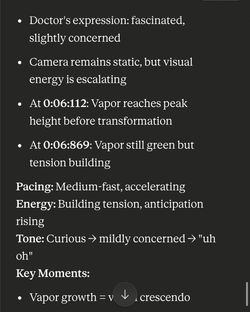
Segment-by-segment breakdown with pacing, energy, and tone analysis
-
Specific timestamp recommendations for musical accents (e.g., "thumbs-up at 0:02:155 should align with rhythmic accent")
-
Tempo automation suggestions mapped to visual intensity (129 BPM → 146 BPM → 155 BPM at peak)
-
Instrumentation recommendations for each emotional shift
Why this matters for AI training: This demonstrates my ability to structure complex creative problems for AI comprehension, provide detailed technical context, and iterate toward production-ready solutions. The AI learned to connect visual timing with musical structure—exactly the kind of multimodal understanding next-gen models need.
 |  |  |
|---|---|---|
 |  |  |
 |  |

Mixing & Mastering
🔊 Project 2: Mastering Loudness Troubleshooting
Challenge: My mixes sounded clean and balanced but weren't achieving competitive loudness compared to professional references.
Approach: I used ChatGPT as a diagnostic partner, working through a complex technical problem over multiple iterations.
What I provided to the AI:
-
Detailed problem description ("My mix is clean but not loud enough")
-
Comparative context ("Other producers' beats sound crisper, exponentially louder")
-
Technical observations ("No clipping, not too much low/mid/high, but they feel weightless")
-
Reference comparison (reference beat vs. my production)
What the AI delivered:
-
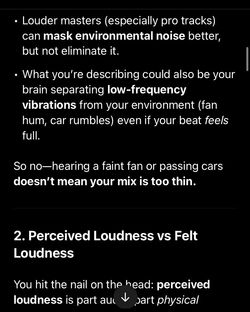
Diagnosis of multiple contributing factors (gain staging, perceived vs. actual loudness, master bus processing)
-
Specific technical solutions with values (-6dB to -3dB pre-mastering peaks, -9 to -6 LUFS targets)
-
Explanations of psychoacoustic concepts (saturation for harmonic richness, transient shaping for punch without volume)
-
Differentiation between overthinking and genuine issues (comparison table format)
Why this matters for AI training: This shows I can teach AI to diagnose subjective audio issues objectively, provide context for comparative analysis, and refine understanding through iterative questioning. These conversations create training data for AI to understand real-world mixing challenges.
 |  |  |
|---|---|---|
 |  |  |
 |  |
🎛️ Project 3: Genre-Specific Production Consulting
Challenge: Determine appropriate hi-hat panning for a soulful R&B production with live instrumentation, balancing modern trends with organic aesthetics.
Approach: I used ChatGPT to understand current industry standards, then refined the AI's recommendations by providing specific genre and instrumentation context.
What I provided to the AI:
-
Initial question: "What's the industry standard for hi-hat panning right now?"
-
Genre clarification after initial response: "It's an R&B beat but not like r&b pop it's soul for sure I have guitars and strings and a unison octave piano countermelody electric bass acoustic type sounds"
-
Creative context: Modern bounce with nostalgic vibe
What the AI delivered:
-
Current Industry Trends: Breakdown by genre (Hip-Hop/Trap, Pop/R&B, Boom Bap/Old School)
-
Technical Specifications: Slight off-center (10-15%), alternating/stereo bounce, stereo widening techniques, super narrow/mono for minimalist styles
-
Adapted Recommendations: "Hi-Hat Placement Options for Soul/R&B" with specific percentages and reasoning
-
Context-Aware Guidance: How live instrumentation affects panning decisions ("works especially well with acoustic textures so the hats don't feel artificial")
Why this matters for AI training: This demonstrates context-aware technical consulting—teaching AI to understand genre nuance where "soulful R&B with live instrumentation" requires different treatment than trap. Shows my ability to refine AI understanding through clarification and guide it from general knowledge to specific creative application.
 |  |  |
|---|---|---|
 |  |  |
 |  |
View my complete music and creative portfolio, featuring original compositions, production work, and additional case studies.